FROM THE STAGE: YOU DON'T NEED PERMISSION TO SHAPE CULTURE. MAGGIE REDLING AND COLEMAN WILLIAMS ON THE BEHAVIORS THAT BECOME YOUR NORMS
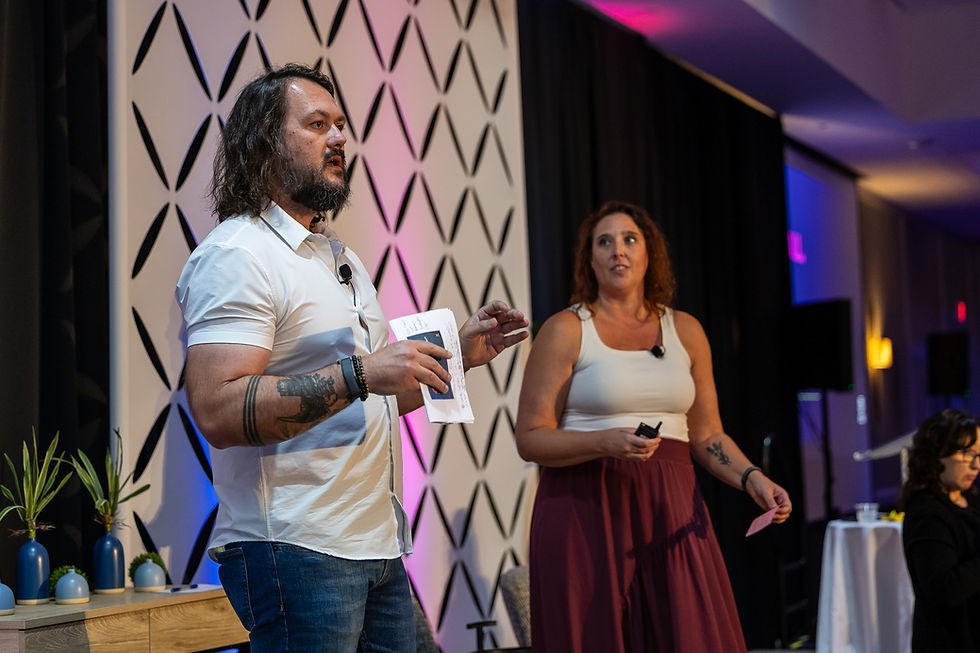
You don't need permission to shape culture, because culture is built out of everyday behaviors rather than decisions handed down from the top. Maggie Redling and Coleman Williams proved it at CultureCon 2026 by getting every table in the room to build one in about ten minutes without meaning to.
Key takeaways
Culture gets built in ordinary moments, not initiatives. Every table in the room built one in about ten minutes without meaning to.
Your behavior is a signal, and the reading is not yours. You choose the tone, the face, the words. Everyone else decides what it meant.
Repetition is what turns a reaction into a norm. Do it once and it is a moment. Do it every time and it is the culture.
Start with the sphere you actually control. Then influence. Then stay out of concern, where the what-ifs eat the clock.
No action is also action. What you decline to address, your team files as permission.
Four moves are available at any level: reinforce, tolerate, clarify, amplify. None of them require a title.
There were note cards on every table.
Maggie Redling and Coleman Williams handed the room a scenario. Forty-eight hours to launch. Call it a new onboarding program, a new project, whatever the biggest thing on your plate is. Then someone on your team flags a credible risk, and nobody knows whether it actually reaches the customer.
What do you do next? One card per table. Two minutes.
Coleman went first, out loud, to show what an honest answer looks like.
“I would probably say something like, all right, let's get this fixed. I'll order us some Chipotle for dinner, and we're going to figure out if this risk is credible. I promise to get you home by 11:00 p.m., maybe 12:00, but we're going to do this. We got this.”
Hold onto the Chipotle. It comes back.
Redling is a cofounder and Chief Experience Officer at Wrestling With Talent, with more than 15 years in talent management, learning, and leadership development. Williams is cofounder and CEO, bringing more than a decade of expertise in HR, learning, and talent management. Together they build tailored people programs for scaling organizations, and they have been coming to CultureCon for six years.
They also gave the audience fair warning about the format. This was not a we-talk-you-listen session.
“This is not a we talk kind of thing. This is a we talk kind of thing. So, just heads up if that makes you uncomfortable, hide now.”

What is not yours to decide?
Once every table had a plan, they moved the goalposts.
A senior leader walks into the room. Make it happen. It is not moving. Even if the risk is real, we are not doing anything differently.
Faces changed around the room. So Redling and Williams started crossing things off. You have no control over the launch date. No control over the budget. No control over the scope. No control over the senior leader's approval.
Then they sent everyone back to their card to cross out anything that was never theirs, and to write something they could actually do.
The tool underneath the exercise is the one Williams reaches for most: spheres of control, influence, and concern.
Control is the center. How I respond. My attitude. How I write the email, how I talk to my senior leader. Influence is the next ring out: the data points that might change her mind, the consequences worth naming before the date holds.
The outer ring got a laugh, and then a serious point.
“And then the last sphere, sphere of panic. No, sphere of concern.”
That is the ring where the what-ifs live, and with forty-eight hours on the clock it is the expensive one. I do not have enough resources. I do not have this. Williams was blunt about where that ends up: keep dwelling there and you will not get it done. Part of the job is pulling your team back out of it and pointing them at the task in front of them.
Now trade cards with the next table
The second move is the one that made the session land. Pass your card to another table. Read a stranger's plan. Then, without judging the move itself, answer three questions about the team behind it.
If I worked here, what would I think matters most?
What feels safe to say on this team, and what does not?
Which behavior is likely to be repeated?
Redling made Williams do it live with her card first. What matters most? Achievement. Getting it done regardless of cost. What is safe to say? Repeat the risk, then bring a solution. Anything that sounds like “this isn't going to work” is not going to work in that conversation. What gets repeated?
“Unfortunately, it feels like we could do a lot of late nights, do a lot of heroics. Chipotle in this case.”
Nobody wrote “we run on heroics” on a card. It was legible anyway.
The same words, two different messages
Then the room reported back, and the best answer was an accident.
One table could not agree on what they had read. Some people heard “just get this done” as a demand. Others at the same table heard the same sentence as a rally cry, encouraging, we are in this together.
Same words. Same card. Two cultures.
“That's interesting that you can get the exact same words, but it turns out into a different interpretation.”
Another table landed somewhere different entirely. Their card was about getting the right roles in the room before acting, which told them the team had some safety in it: people could ask “do we have the right people?” without pretending to have all the answers. Very people-focused. Very focused on clarity.

Every table built a culture without deciding to
That was the whole point of making them write it down.
“Each of you built a small little culture at your own table.”
Every table decided what was good, bad, or indifferent, and what action should and should not happen. And every one of them produced a different move. Some more people-focused. Some more achievement-focused. Some wishing, in hindsight, that they had pushed back on the senior leader.
None of them chose whether the product launched. That is the part Redling kept returning to. Most of the time we do not get to choose the work. We still shape what the next step looks like.
“My Chipotle midnight is not for everybody and that's a very clear culture whether I meant to or not.”
Which is the sentence to take home. The behaviors inside your sphere of control, how you react, how your face moves, your tone, your word choice, all of it is a signal that other people are reading in real time.
“That behavior is a signal to everyone else around you that then they get to interpret. You don't get to decide how they interpret it. And all of that, if it happens again and again, that's what becomes the norm.”
Reinforce, tolerate, clarify, amplify
The framework is four questions you can ask in any role, at any level, on any day. What do I want to reinforce? What will I tolerate? What do I want to clarify? What do I want to amplify?
Williams tried to make the letters spell something and gave up on stage, which is now the most memorable part of it.
“Retracka doesn't roll off the tongue?”
The four moves in practice:
Reinforce. Name it out loud. Say you want it, or say you do not.
Tolerate. Name that too, honestly, and watch what happens when you do nothing. As Redling put it, no action is also action.
Clarify. Ask questions. Get down to the actual expectation instead of assuming it is shared.
Amplify. Push on the things that already work, the ones that make the team feel good.
They were emphatic that this is not a leadership exercise. It does not matter who you are in the organization. If you do lead a team, that is where most people start, because you are there every day and you can see it. But the same four questions scale up to how a whole company decides what it is okay with.

What happens when you say nothing?
The last exercise was personal. Think of one recurring moment at work. Write down what people learn when you let it slide, and what you would rather they learn instead.
Williams used the smallest possible example, on purpose. People start showing up five minutes late to every meeting. You do not address it. Five becomes the new normal, then five becomes ten. What you wanted them to learn was that starting on time is a sign of respect for everyone else in the room, and that things happen, and both of those can be true.
He was careful not to moralize it: if five minutes late genuinely is your culture, fine. The question is whether you chose it.
Two attendees shared theirs. The first: when a failure to have structure happens and I say nothing, people may learn that being disorganized is something to get used to, when what I want them to learn is that structure and planning make it possible to actually finish the thing.
The second was messier and better for it. A newer manager on a hybrid team, inheriting a norm she did not set, where people go remote without telling anyone. If she never checks in, people learn that is fine. What she wants is a heads-up ahead of time, which is a small ask and a real culture shift. She admitted on the microphone that this was exactly why she had not raised her hand.
Both answers had the same shape. A behavior nobody addressed, quietly becoming policy.
Thirty seconds, then thirty days
They closed by asking for a commitment, not a discussion.
Thirty seconds. Write down your culture shift for the next thirty days. Nobody has to read it out.
“What is it you're going to do so that whatever becomes the new normal or more normal. Go back and share it with your team. So, you can start to put it into the world. Make it happen.”
Then the same offer they make every year: find us afterward. Culture, accountability, sphere of control.
“We'd love to nerd out with you. Absolutely, it's our favorite thing to do.”
Frequently asked questions
Who are Maggie Redling and Coleman Williams?
Maggie Redling is cofounder and Chief Experience Officer at Wrestling With Talent, with more than 15 years in talent management, learning, and leadership development. Coleman Williams is cofounder and CEO, with more than a decade of expertise in HR, learning, and talent management. They build tailored people programs that align talent strategy with business objectives for scaling organizations.
What does “you don't need permission to shape culture” mean?
It means culture is not controlled by the org chart. It is shaped daily by behaviors: what gets reinforced, what gets tolerated, what gets clarified, and what gets amplified. Anyone can influence those behaviors from any seat, and waiting for authority to do it is what makes culture stall.
What is the Reinforce, Tolerate, Clarify, Amplify framework?
Four questions to run on any recurring situation at work. What do I want to reinforce, meaning name it and say I want it? What will I tolerate, knowing that no action is also action? What do I want to clarify, by asking questions and getting to the real expectation? What do I want to amplify, meaning push harder on what already works? None of the four require a title.
What is the sphere of control, and how do you use it?
It is three rings. Control is what is entirely yours: your response, your attitude, your tone, how you communicate. Influence is what you can move with data and honest consequences, like a leader's decision. Concern is everything else, where the what-if scenarios live. Under time pressure the practical move is to act in the first ring, work the second, and keep yourself and your team out of the third.
Why did the session use note cards and table exercises?
Because the argument only lands if you see it happen. Every table wrote its own response to the same scenario, then traded cards and read a stranger's plan. Each table had produced a legibly different set of values in about ten minutes, without anyone deciding to. That is the mechanism the session is about, demonstrated rather than described.
What was the one action attendees left with?
Write down one culture shift to initiate within the next 30 days, then go back and share it with your team so it exists outside your own head.
CultureCon is becoming WorkPossible
In 2027, our tenth year, CultureCon becomes WorkPossible. We've grown out of being just a conference and we needed a name that could keep growing with our expanded services. But despite the name change, culture is still the heartbeat of our organization. That's never going to change.
WorkPossible is the belief that work can be a force for good, and that when people come together with curiosity and purpose, incredible things become possible.
Early bird tickets for WorkPossible 2027 in Madison are available now. Get yours here
Work, made possible by the people who do it.
This recap was written with the help of AI from Maggie Redling and Coleman Williams's session at CultureCon 2026, then reviewed by our team.

Comments