FROM THE STAGE: RED BALL TENNIS AT WORK. ROB GORDEN ON PUTTING A TENNIS COURT IN YOUR BREAK ROOM
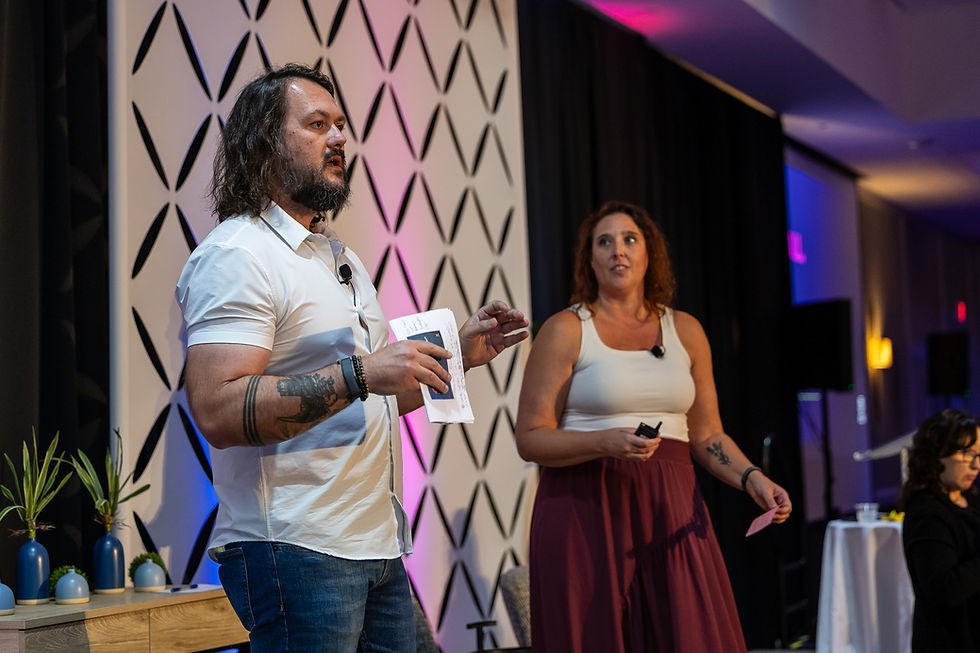
Red ball tennis is a modified version of the game played on a smaller court with a lighter racket and slower foam balls, and it turns people who have never played into players in seconds. Rob Gorden of the USTA came to CultureCon 2026 to give the equipment away.

Key takeaways
The barrier to most workplace wellness is competence, not interest. People don't avoid the activity. They avoid being bad at it in front of colleagues.
Change the equipment and the barrier disappears. Smaller court, lighter racket, slower foam ball. Gorden went from never-player to playing in about ten seconds.
Red ball tennis fits where you already are. No line regulations, so an unused boardroom, a warehouse, or a parking lot all work.
Twenty minutes is roughly a short walk. No changing clothes, no showering, no making the next meeting awkward.
The USTA gives the equipment away. Rackets, foam balls, a net, and a waiver, at no cost, because growing the sport is the nonprofit's actual job.
Rob Gorden opened with two questions.
Do you like fun? Do you like free?
Then he explained why the United States Tennis Association had a booth at a workplace culture conference, which is a fair thing to wonder about. His answer was that tennis is, by his citation, the world's healthiest sport: played regularly it adds close to ten years to your life, lowers blood pressure, and carries a social benefit he described as insanely good for you.
Then he did the thing that made the talk work. He undercut himself.
Rob Gorden did not play tennis
He walked the room through the obvious assumption. Clearly he must be a former professional. Clearly we all saw him at Wimbledon in 1993 battling Pete Sampras.
“Spoiler alert, that wasn't me.”
He had tried tennis once. It was, in his words, an absolute disaster. Difficult, frustrating, and there were too many other things to do. So he was not going to play tennis. He was going to watch tennis, because watching tennis was his job.
Then a colleague at the USTA asked when he was going to start hitting. He said he wasn't. She asked why.
He told her he couldn't keep it in the lines, and that the moment he did manage to keep it in the lines, he got tennis elbow.
“And she said, I can change all of that in 30 seconds. And I went, yeah, right.”
She took him to a smaller court. He called it a baby court. She told him it was a tennis court, just smaller than the one he was used to seeing. Then she pulled out a foam ball and asked whether he thought he could hit it.
“And my friends, not 30 seconds later, 10 seconds later, I was a tennis player.”
He is now, by his own rating, a 3.0. He noted he would be a 3.5, except that he works in tennis.

What red ball tennis actually is
Three changes to the equipment, and that is the entire innovation. A smaller court. A lighter racket. Slower balls.
What those three changes produce is the thing that matters for a workplace program: instant success. Nobody spends twenty minutes shanking balls into a wall while their coworkers watch.
And because there is no regulation governing where the lines go, it fits almost anywhere. An unused boardroom. A conference room nobody books. A warehouse. A parking lot. Indoors or out. The foam balls will not damage anything they hit.
His preferred setup is a semi-permanent space employees can walk into and start playing immediately.
“Twenty minutes of red ball tennis is much like taking a walk outside for a couple blocks. It's the same amount of exercise and it's not going to make the next meeting uncomfortable for everybody.”
That sentence is doing more work than it appears to. Most workplace fitness offerings fail on logistics rather than enthusiasm: they require changing, sweating, and showering, which means they require a block of time nobody has. This one is designed around the lunch hour a person actually has.
Who it's for, which turns out to be everyone
Gorden ran through the audiences, and the range is the argument.
People who have never swung a racket. Never played tennis, pickleball, padel, or racquetball. The whole design is for them.
The tennis purist. The colleague who insists tennis has to be played a certain way. His reframe: your job is to introduce someone to the sport you love, and this is how you do it.
Strong players with less-strong friends. He was candid that on a full court with a yellow ball, he isn't worth the time of the USTA colleagues who have played the US Open. He can't return the serve, there's no rally, and nobody has fun. On a red ball court they can play together and enjoy it.
Fitness enthusiasts. As a complement to whatever else they're already doing.
Former players. Someone who played in high school and hasn't picked up a racket since.
“Well, welcome back. We'd like to give tennis back to you.”

“We host a book fair annually in New York City”
The obvious question from a room of HR budget-holders was how any of this could be free. Gorden's answer was the biggest laugh of the showcase.
“United States Tennis Association, we host a book fair annually in New York City in late August and early September. It's called the US Open. We make a couple bucks. Not a big deal.”
That, he said, has made them a very wealthy nonprofit whose actual mandate is to grow the sport. His specific job is growing adult participation, which is why the equipment goes out at no cost.
A starter kit is four adult 23-inch rackets, shorter and lighter than a standard racket but built for adults, a supply of foam balls, and a net. They stock two net sizes depending on the space.
The HR case
Gorden's pitch to the room was not really about tennis. Easy entry. It creates happiness. It's good for stress release, with the possibility of fewer sick days and fewer mental health days. It's a team-building activity that does not feel like a team-building activity. It's a genuinely unusual thing to mention when you're recruiting: there's a court in the conference room and we play every Friday.
And they provide a waiver, which is the unglamorous detail that determines whether this ever gets past your risk team.
For what it's worth, CultureCon 2026 ran a court in the room across the hall all week, and red ball tennis showed up in the conference's own opening video. Which is roughly the level of proof his argument needed.
Frequently asked questions
What is red ball tennis?
A modified version of tennis played on a smaller court with a lighter, shorter racket and slower foam balls. The equipment changes are designed to produce immediate success for people who have never played, and the smaller footprint means it can be set up in spaces a regulation court would never fit.
Can you really put a tennis court in an office?
Yes, because there is no regulation governing where the lines go for this format. Setups described in the session included unused boardrooms and conference rooms, warehouses, parking lots, and outdoor spaces. The foam balls will not damage surroundings.
How much exercise is twenty minutes of red ball tennis?
Roughly comparable to walking a couple of blocks outside, per Gorden. The practical point is that it does not require changing clothes or showering, so it fits inside a normal lunch break without disrupting the rest of the day.
Does the USTA really give the equipment away for free?
That was the offer made from the stage: four adult 23-inch rackets, foam balls, and a net, along with a waiver, at no cost. The USTA is a nonprofit whose mandate is growing participation in the sport, and it is funded substantially by the US Open.
Why would an HR or People team care about workplace tennis?
The case made here was easy entry with no skill barrier, a stress-release outlet during the workday, potential reductions in sick days and mental health days, a team-building activity people opt into rather than endure, and a differentiator when recruiting.
Who is Rob Gorden?
Rob Gorden works at the United States Tennis Association, where his focus is growing adult participation in tennis. He presented in the Innovation Showcase at CultureCon 2026 in Madison, Wisconsin. By his own account he did not play tennis at all until a colleague put him on a smaller court with a foam ball.
CultureCon is becoming WorkPossible
In 2027, our tenth year, CultureCon becomes WorkPossible. We've grown out of being just a conference and we needed a name that could keep growing with our expanded services. But despite the name change, culture is still the heartbeat of our organization. That's never going to change.
WorkPossible is the belief that work can be a force for good, and that when people come together with curiosity and purpose, incredible things become possible.
Early bird tickets for WorkPossible 2027 in Madison are available now. Get yours here
Work, made possible by the people who do it.
This recap was written with the help of AI from Rob Gorden's Innovation Showcase presentation at CultureCon 2026, then reviewed by our team.


Comments