FROM THE STAGE: THE TRUST RECESSION. ROD BERGER ON WHY TRUST MIGRATED FROM POSITION TO PROXIMITY
"In a trust recession, story is the asset class that holds when all others fall."
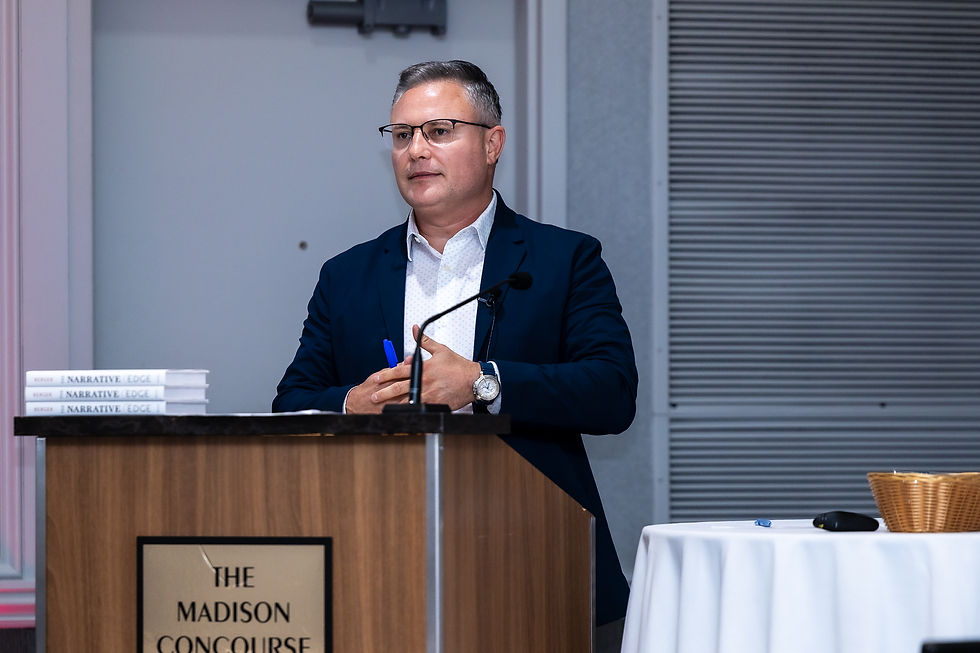
Dr. Rod Berger, CultureCon's Storyteller in Residence, brought that line to CultureCon 2026 in his session "The Trust(ed) Co-Author: Sourcing the Stories That Rebuild Trust Inside Your Organization."

Key takeaways
Trust now lives in proximity, not in position. The leaders inside the 66% are the ones whose stories live close enough to be heard.
70% of people are unwilling or hesitant to trust someone whose values, background or worldview differs from their own. Edelman calls it insularity.
Most professional lives are built out of assigned stories rather than authored ones, and so are most companies.
The work runs in three moves: source, examine, author.
The Four Quadrants (Personal, Professional, Passions, Pursuits) map where a leader's stories live. Rod says Passions is the quadrant most leaders have starved without naming it.
The Authorship Declaration
"Most of us are living inside stories we never chose to author."
They were handed to us, Rod's opening slide says. By parents, teachers, managers and leaders, cultures and environments, and industries. Each one needed us to perform a particular role inside their particular narrative. The moment we're in is the moment those inherited stories are starting to crack.
Trust did not evaporate. It migrated.
The 2026 Edelman Trust Barometer, drawn from roughly 34,000 respondents across 28 countries, found that 70% of people are unwilling or hesitant to trust someone whose values, background or worldview differs from their own. Edelman calls it insularity.
Rod's slides showed where that trust went. Over five years, trust in national government leaders fell 16 points, major news organizations 11 and foreign business leaders 6. Trust in "my CEO" rose 9 points, and trust in coworkers and in neighbors, family and friends rose 11. Globally, 66% of employees now trust their CEO.
"The we has become me. Trust now lives in proximity, not in position."
Gallup's 2026 State of the Global Workplace puts global employee engagement at 20%, its lowest reading since 2020. Manager engagement is at 22%, down 9 points since 2022. Rod's slide put it this way: "The premium is gone. The people paid to carry the story have stopped believing it."
In SHRM's 2026 CHRO Priorities Report, 46% of CHROs rank leadership and manager development as their number one priority for 2026, the second year in a row.

Authored versus assigned
An authored story is one you have examined, claimed, and chosen to live inside. An assigned story is one that was handed to you. Most professional lives are built almost entirely out of assigned stories. So are most companies.
Then his business card question:
"If I removed your title, your company name, and every credential after your name, what story would you tell about who you are and why you do this work?"
The Four Quadrants and the Narrative Stack
Rod maps a leader's stories across four quadrants:
Personal: the stories of your inner life, relationships, and identity. The chapter your team rarely sees.
Professional: career advancement and professional skills, ambition and goal-setting.
Passions: what lights you up, what you would do for free. The quadrant most leaders have starved without naming it.
Pursuits: what you are chasing, building, or becoming. The roadmap. Where most leaders are most fluent.
The Narrative Stack adds four pillars: coherence, conviction, legibility and resonance.
Trust(ed): read it both ways
In the session title, Trusted is what the work has to earn. Trust is what the work is actually about. And (ed) is the educator's role inside the partnership.
"I do not write your story. I educate you in how to source it, examine it, and tell it in a way that meets the moment."
The method is three moves.
Source. The Knockout Questionnaire. Questions designed to get past the prepared answers and into the territory where the actual stories live. Questions they have never heard, about stories they have always carried.
Examine. Which stories are authored? Which were assigned? Where is the story doing work for you, and where is it quietly costing you? This is the part that requires sitting with discomfort.
Author. Shape the story into something the leader can deploy. In a board meeting. In a difficult conversation. In the moment that calls for them to meet the moment instead of dodging it.
The knockout questions
Rod gave five, each at the intersection of one quadrant and one pillar, designed to be carried home.
Professional × Coherence. If I sat down separately with your board chair, your head of HR, and the person who has worked for you the longest, and I asked each of them why your organization exists, would I hear three versions of the same story, or three different stories?
Personal × Conviction. What is the chapter of your life you have stopped telling at work, and what would it cost you to put one sentence of it back on the table?
Passions × Resonance. When was the last time you let a room see you care about something that was not on your scorecard, and what happened to the temperature of that room when you did?
Pursuits × Legibility. If your most important external audience for the next twelve months described your organization in their own words tomorrow, would the description match the one you have been telling yourself?
The through-line. Are you the author of your story, or are you a character in someone else's? And which of the four quadrants will tell you the truth first if you ask it?
Oslo, 2024
Rod's own example: backstage in Oslo in 2024 with Jonas Helmikstøl, he broke the fourth wall, told him about the death of his own company, and the usual interviewer-guest dance dissolved. He sourced Jonas's story, examined it with him in real time, and helped him author a version he could put back into the world. His slide calls it "the story that reached Davos before the data did."
His take-home exercise was a six-word story, with Hemingway's "For sale: baby shoes, never worn" as the example. He closed with one more question: "If trust is retreating to the inner circle, what story do you want to be telling, with a steady voice and a clear conscience, when your team finally turns around to look at you?"
FAQ
What does "trust migrated" mean?
Trust in distant institutions has fallen while trust in people close to us has risen. Over five years, trust in national government leaders is down 16 points, while "my CEO" is up 9 and coworkers, neighbors, family and friends are up 11.
What is the difference between an authored and an assigned story?
An authored story is one you have examined, claimed and chosen to live inside. An assigned story was handed to you by parents, teachers, managers, cultures or industries. Rod says most professional lives and most companies are built almost entirely out of assigned stories.
What are the Four Quadrants?
Personal, Professional, Passions and Pursuits. They map where a leader's stories live. Rod says most leaders are most fluent in Pursuits and have starved Passions without naming it.
Why does manager engagement matter to trust?
Global employee engagement is at 20%, its lowest since 2020, and manager engagement is at 22%, down 9 points since 2022. In Rod's words, the people paid to carry the story have stopped believing it. 46% of CHROs put leadership and manager development first for 2026.
What is the Trust(ed) Co-Author method?
Three moves. Source the story with questions that get past prepared answers. Examine which stories are authored and which are assigned. Author a version the leader can use in a board meeting or a difficult conversation.
CultureCon is becoming WorkPossible
In 2027, our tenth year, CultureCon becomes WorkPossible. We've grown out of being just a conference and we needed a name that could keep growing with our expanded services. But despite the name change, culture is still the heartbeat of our organization. That's never going to change.
WorkPossible is the belief that work can be a force for good, and that when people come together with curiosity and purpose, incredible things become possible.
Early bird tickets for WorkPossible 2027 in Madison are available now. Get yours here
Work, made possible by the people who do it.
Written from the slides of Dr. Rod Berger's session at CultureCon 2026, with AI assistance and human review.


Comments