FROM THE STAGE: BUILDING A HUMAN BUSINESS. GLENN BOSTOCK ON REWARDING MISTAKES AND RUNNING A COMPANY LIKE A BODY
Updated: 7 days ago
Glenn Bostock has run SnapCab for 25 years on a rule most companies would never write down: reward people for mistakes. At CultureCon 2026 he told the room how he got there, starting with the employee he yelled at and the same employee he later sent to Hawaii.

Key takeaways
Reward people for raising problems. Every SnapCab employee who posts a mistake on the board gets a carnival ticket. The monthly winner spins a prize wheel for an extra vacation day, $100, or a gift certificate.
The gold is in the problems. He learned the line at a lean manufacturing school alongside jet engine engineers. Identify a problem and solve it, and it's like finding money on the street.
People are led by what they love. Hire for the thing a person loves to do, then find where it meets what the company needs. He hired a former EMT with no woodworking skill over the best craftsman in town, because the EMT wanted to take care of people.
Put usefulness first. Everyone is motivated by money, reputation, and being useful to others. Lead with usefulness and the other two grow on their own.
Run the company like a body. The leadership team is the head, management is the nervous system, and every part is co-essential. Competition between departments, in body terms, is sickness.
Start with the part you control. Write an intention statement for your own department and change that. Other departments come to look.
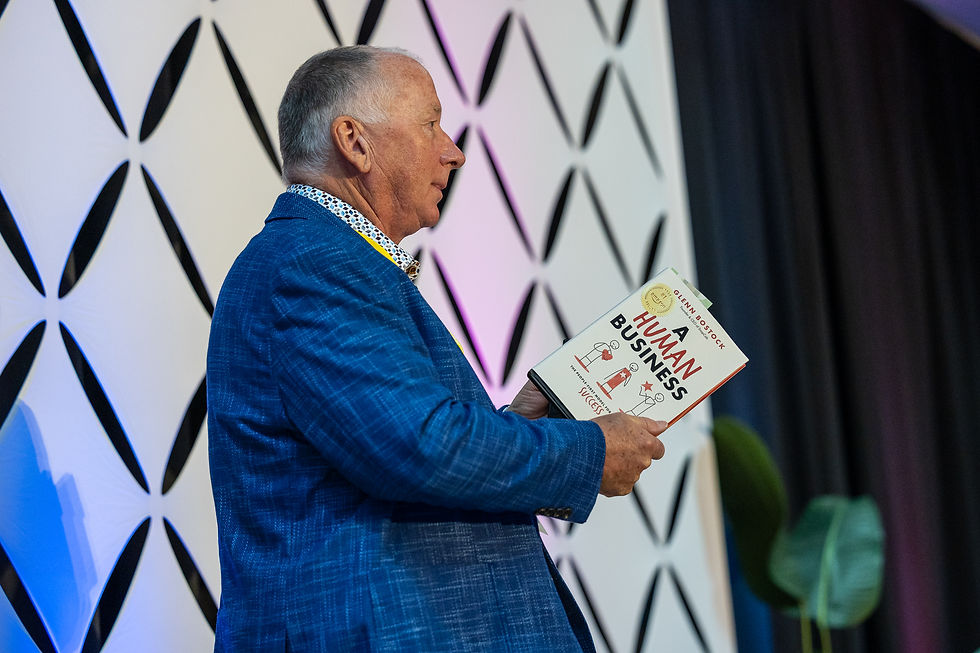
Glenn Bostock opened the final day of CultureCon 2026 by telling the room he was their newest employee.
It was his first year as a speaker, in his 44th year of being self-employed, so he decided the audience was now his boss. "I'm employed by you now. I think you guys are my customer. I hope you treat me well, because I'm a newbie." Then he held up his speaker name card, which had been flipping around on its swivel to show a blank back. He had written his name on the other side to mistake-proof it. And since SnapCab rewards people for mistakes, he called Zach Blumenfeld up to the stage and handed him a copy of his book and a Canadian twenty-dollar bill.
Bostock is the CEO of SnapCab, with a factory in Warrington, Pennsylvania that makes elevator interiors and one in Kingston, Ontario that makes office pods. His book, A Human Business, was published by Forbes Books in June. The first part of his career, in his words, taught him how not to run a business. The last 25 years have been an experiment.
"In the last 25 years, we've been running an experiment at SnapCab. We call it the human business. It's the only place that I know that runs it quite the way we do it."
Bob, Mexico, and Hawaii
Early on, SnapCab ran the way most companies do. An employee named Bob shipped a job to Mexico with mistakes in it. The customer rejected it. It cost Bostock money and it cost him reputation.
"I thought, I'm going to yell at Bob. That way he'll be incentivized not to do that again. Even better, I'm going to yell at Bob in front of his peers."
Around the same time, he went to see a man named Peter, a retired parole officer who had spent his career with prisoners whose egos had put them there. Peter told him people are led by what they love. Bob loved working with his hands and making elevator interiors, and Bostock had yelled at him right at the point where he found joy in his work. The job that went to Mexico had gone out through a system Bostock built, with no quality check before shipping.
"Peter said, 'You know, Glenn, the problem isn't your wife, and the problem isn't your workers. The problem's in between your ears. The problem is your thinking.'"
Peter's framework was three motivators everyone shares: money, reputation, and being useful to other people. The order matters. Put money first and usefulness last and you are fighting uphill. Put usefulness first, hire people who want the same, and reputation and money show up on their own. Bostock cited the engagement math along the way: an engaged worker is three times as productive as a disengaged one.
Not long after, Bob used the wrong material on a job and shipped it to Hawaii. This time Bostock sent Bob and his wife to Hawaii. They spent one day replacing the ceiling and the rest of the week on a paid vacation. When Bob got back, Bostock asked him what had happened. The ceiling was supposed to be a glossy mirrored finish and had gone out matte, because nobody checked the peel coat. Bob built an incoming inspection system for materials: right material, right size, no defects, before anything gets built.
"He has saved me hundreds and hundreds of thousands of dollars over the years."
Where "the gold is in the problems" came from
Through Otis Elevator, Bostock ended up at a quality school run by United Technologies, learning lean manufacturing next to Pratt & Whitney and Sikorsky engineers whose mistakes could cost lives. "I'm just there as like an elevator decorator," he said. The teacher's line that stuck: the gold is in the problems. Identify one and solve it, and it's like finding money on the street.
The teacher also gave him a word for anything that hinders the flow of work: a turnback. If Frank takes your hammer, that's a turnback. If you get mad at Frank about it, that's a bigger turnback, because now the relationship is damaged too. The root cause fix is two hammers.
Peter and the quality school were saying the same thing from two directions. One said observe the problem in your mind. The other said observe the problem in your workplace. Bostock dropped punishment altogether.
"The prison system uses punishment to control prisoners. And I'm like, oh, that's what I was using to control my employees. Wow, I'm treating them like prisoners."
How SnapCab rewards mistakes today
Around the office and factory are about 14 boards where employees post what went wrong, by category. Instead of a sit-down management meeting, the leadership team walks the boards every day and the employees present the problems. In Canada, every employee gets an hour a day, on a four-day, ten-hour schedule, to improve their work area or train.
Every Post-it note earns a carnival ticket. At the monthly meeting, whoever has the most tickets spins a prize wheel for an extra vacation day, $100, or a gift certificate.
"So we're rewarding people literally for making mistakes. Nobody actually, it's not worth it, $100 to make a mistake. But to lower the fear around making mistakes."
In Q&A he added the one time this nearly went wrong. Early on, a co-worker suggested rewarding people for solutions instead. Another pushed back: the bigger thing you want is people bringing up what's going wrong at all. Rewarding solutions started competition over who got credit, and goodwill started going out the window. They went back to rewarding the problem.

Hire for what people love
SnapCab hires for what it calls a ruling love, the thing a person most loves to do, and then looks for where that meets what the company needs. Bostock gave the room two candidates. One was an experienced craftsman who said nobody in town was better. The other had wanted to be an EMT, could not handle the sight of blood, and was looking for work.
"I hired the EMT because this EMT had a desire to be caring for people. And guess what? You can train EMTs to use saws and squares."
Expertise can be hired, he said, and then he tried to manage those people into being engaged and it did not work. Goodwill has to be hired for. The company's stated DNA is three words: be kind, be authentic, be useful. His version of why values matter: every cell in your body knows its job because of the DNA, and the cells growing without the DNA are cancer.
"Where better place to find meaning in life than a well-designed workplace? I think our problem is that they're currently not very well designed."
Why a body and not a machine
Bostock uses his own body as the model. When he gets a pebble in his shoe, his foot becomes the boss and the whole body stops to deal with it, the way a Toyota line worker can pull the cord and stop production. The leadership team is the head. Management is the nervous system, carrying messages back and forth. His financial team is quiet until check fraud shows up, and then his phone lights up. A stomach ache is information.
"In your body, every part is co-essential to every other part. Your lungs cannot do its job without your heart. Your heart can't do its job without the lungs."
Competition between departments, in body terms, is sickness. Problems are pain signals that tell you where to put your attention. And the body grows by going through problems: a cold builds the immune system, a torn muscle builds more muscle. "Lucky for us, the gym comes to us. The problems come for free to us at work all the time."
The five principles of a human business
Create a foundation of caring.
Leverage your primary motivator, fulfilling your life purpose at work.
Focus on being useful.
Embrace problems and weaknesses. Share what is going wrong without blame or retribution.
Model your business after the human form, replacing competition with collaboration.
For over 25 years those principles have guided who SnapCab hires, how they lead, and the culture they protect.

Start with the part you control
Asked in Q&A how to bring any of this into an organization with a mess of management styles, Bostock said to write an intention statement and a vision for the part of the organization you control. Spend your time with the people who want to see it happen. Change one department, and you become the example the others come to look at.
For the colleague who arrives certain they have the one answer, he uses a rating exercise: ask for three solutions, write down every criterion the different stakeholders care about, and score each option one to five together. It helps the person see there is more going on than they realized.
Frequently asked questions
Who is Glenn Bostock?
Glenn Bostock is the CEO of SnapCab and the author of A Human Business, published by Forbes Books in June 2026. He started as a custom cabinet maker in 1983, invented an elevator remodeling kit that Otis Elevator rolled out across North America, and has run SnapCab for the last 25 years as what he calls a human business. He opened the final day of CultureCon 2026 in Madison, Wisconsin.
What is a human business?
An organization run like a body rather than a machine. The leadership team acts as the head, management as the nervous system, and every department is co-essential to the others, so internal competition is treated as sickness. It rests on five principles: a foundation of caring, leveraging each person's primary motivator, focusing on usefulness, embracing problems and weaknesses, and modeling the business on the human form.
Why does SnapCab reward employees for mistakes?
Because the behavior the company most needs is people bringing up what went wrong. Every posted mistake earns a carnival ticket and a shot at a monthly prize wheel. The reward is small on purpose. Its job is to lower the fear around admitting a mistake so the system behind it can be fixed.
What does "the gold is in the problems" mean?
Problems are the most valuable information a company has. Bostock learned the line at a United Technologies lean manufacturing school and built SnapCab's culture around surfacing problems without blame.
Should you reward employees for solutions or for raising problems?
Raising problems. SnapCab tried rewarding solutions early on and found it started competition over credit and eroded goodwill. They went back to rewarding the problem itself.
How do you start building a human business inside an existing company?
Start with the part of the organization you control. Write an intention statement and vision for it, spend your time with the people who want the change, and let one transformed department become the example others visit.
CultureCon is becoming WorkPossible
In 2027, our tenth year, CultureCon becomes WorkPossible. We've grown out of being just a conference and we needed a name that could keep growing with our expanded services. But despite the name change, culture is still the heartbeat of our organization. That's never going to change.
WorkPossible is the belief that work can be a force for good, and that when people come together with curiosity and purpose, incredible things become possible.
Early bird tickets for WorkPossible 2027 in Madison are available now. Get yours here
Work, made possible by the people who do it.
This recap was written with the help of AI from the full recording of Glenn Bostock's session at CultureCon 2026, then reviewed by our team.


Comments